
Most people who search for how to start tuition classes at home have already figured out the hardest part: they know a subject well and maybe have helped their neighbour’s kids or siblings with it.
But one thing that usually stalls them isn’t their teaching ability, it’s not knowing how to turn that capability into an actual, high-paying tuition practice with a fair fee, a schedule, and more.
That’s when this guide comes to your help! This is written specifically for tutors and parents. Before we start, remember that no tutor gets 15 students in their first batch, every tutor starts slowly, and gradually the number of students increases.
How to Start Tuition at Home: A Complete Guide
Why is this worth doing right now?
Let’s first address the elephant in the room! One teacher and thirty students in a classroom leave very little room for individual attention. Parents feel this gap constantly, and it’s a big reason home tuition demand for younger students keeps rising in cities like Lucknow, where school competition has gotten tougher. Home tuition also has almost no overhead compared to a coaching centre. No rent, no staff salaries, just you, a notebook, and a student who needs help.
What do you actually need before you start?
Being the master of a subject can definitely be the biggest perk; there are a few other considerations that you need to know:
- A solid grip on the subject that you are planning to teach, not just basic familiarity. That’s what we told you earlier.
- A few basics on hand, like a whiteboard, sample papers, worksheets, etc.
- A corner of your home that’s usually quiet during teaching hours
- The ability to explain the child’s capability to a parent clearly
- Genuine patience, because every child learns at a different pace
- None of this is complicated, but skipping even one piece shows up quickly.
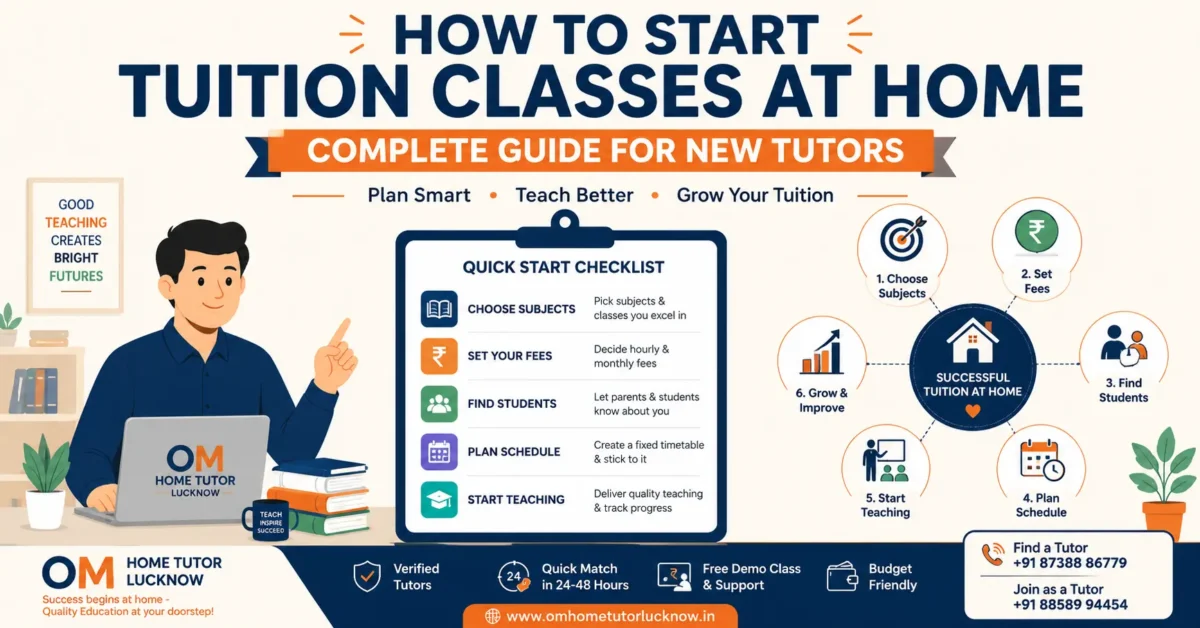
Step-By-Step Approach on How to Start a Home Tuition
Here’s how the process looks like:
- Pick your subjects and class levels
- Don’t stretch across five subjects just because you know them
- Work out your fee structure, both hourly and monthly
- Build a simple weekly timetable and stick to it
- Have a short, honest introduction ready, so that you can tell about your teaching style, education, and why they must choose you for home tuitions
Home Tuition Fees: Hourly and Monthly Rates
While parents tend to think in monthly numbers, on the other hand, tutors tend to think in hourly ones. It helps to walk into that first conversation knowing both.
On an hourly basis, home tuition for primary classes can fall between 150-300 Rupees per hour. Tutors with a B.Ed, real classroom experience, or a specific skill like working with children who have learning difficulties can usually ask for more than that.
On a monthly basis, expect somewhere between 1500 to 4000 Rupees per subject, or a combined package covering Maths, English, Hindi, etc.
Fees for Class 1 and 2 sit closer to the lower end since the syllabus is lighter, while Class 4 and 5 push up as subjects pile up and exam pressure builds. Daily classes cost more than two or three sessions a week, and none of these numbers are fixed, so treat them as a starting point for the conversation, not the final word.
How Much Should I Charge for Home Tuition?
Every new tutor asks this, and it’s a fair question with no exact answer. But the right number comes down to real personal factors, not just because the neighbour is demanding something else.
- Qualification Matters: A trained or postgraduate teacher can reasonably ask for more than a college student may ask for home tuition.
- Experience: Experience with the actual age group, not just years of teaching in general
- Number of subjects covered: How many subjects and hours you’re covering every week.
- Travel Time: Since commute takes up time, so its fair to ask for more
- The local market: Since a busy school-heavy neighbourhood tends to support higher rates.
- One child versus a batch: Batch teaching lowers per-child rates but raises the total income.
Assess these points honestly, and a fair number tends to become obvious pretty quickly.
How to Teach Tuition at Home so Students Actually Stay?
This is where a lot of tutors lose students without understanding the “why” of it. Remember to keep the sessions short and hands-on, and lean on everyday examples instead of textbook-style explanations.
Keep a simple notebook of where each child keeps stumbling, so you’re not relearning it every session. Talk to parents often, even briefly, since a short weekly update does more for retention than almost anything else.
How to Market Yourself or Get Students for Yourself for Home Tuitions?
Getting your first few students can feel harder than actually teaching them. But you don’t need to spend a lot on advertising. Start small and let people know you’re available for home tuition.
Start with your own circle: Tell friends, relatives, neighbours, and parents, know that you’re offering home tuition. Your first student can usually come through someone you already know.
Use WhatsApp: Use a simple status and post it in groups, regarding the subjects you cover, your location, and how parents can contact you. Ask a few friends to share the status on their WhatsApp as well.
Try local groups: apartment, colony, and school-parent groups, as well as local Facebook or WhatsApp groups, can be useful for reaching parents in your area. Just avoid posting repeatedly or making it feel like an advertisement.
Use a tuition platform: If you don’t want to spend time finding students yourself, platforms such as Om Home Tutors Lucknow can help connect tutors with families seeking home tuition.
Become a Content Creator: Share useful educational content on Instagram, YouTube, Facebook, or other platforms. You can create short videos, study tips, subject explanations, exam preparation tips, or simple learning content related to the subjects you teach. Consistent content can help parents and students discover your teaching skills and build trust in you over time.
Growing Further: How to Start a Home Tuition at Home?
Once you get a handful of steady students, some tutors start thinking about how to start a tuition at home instead of teaching one child at a time. That usually means small batches of five to ten kids rather than one-on-one sessions, lowering your per-child rate but raising total earnings. It takes a proper, safe space, decent seating, and a fixed timetable, and the teaching quality has to stay exactly as high as it was with your very first student.
For parents, it is important to check the tutor’s ID card, qualifications, and background before starting home tuition.
Start Your Home Tuition Journey With Om Home Tutors Lucknow
This is exactly why Om Home Tuition was actually built. It connects tutors to families who are actually looking for experienced tutors without having to struggle to call their neighbours or relatives.
Figuring out how to start tuition classes at home stops feeling overwhelming once you break it into pieces, and that includes knowing your fee range, learning how to teach tuition at home in a way kids respond to, and growing toward how to start a tuition centre at home once you’re ready.
If you’re done planning and are ready to actually teach, or you’re a parent looking for a verified teacher in Lucknow, get in touch with us today!