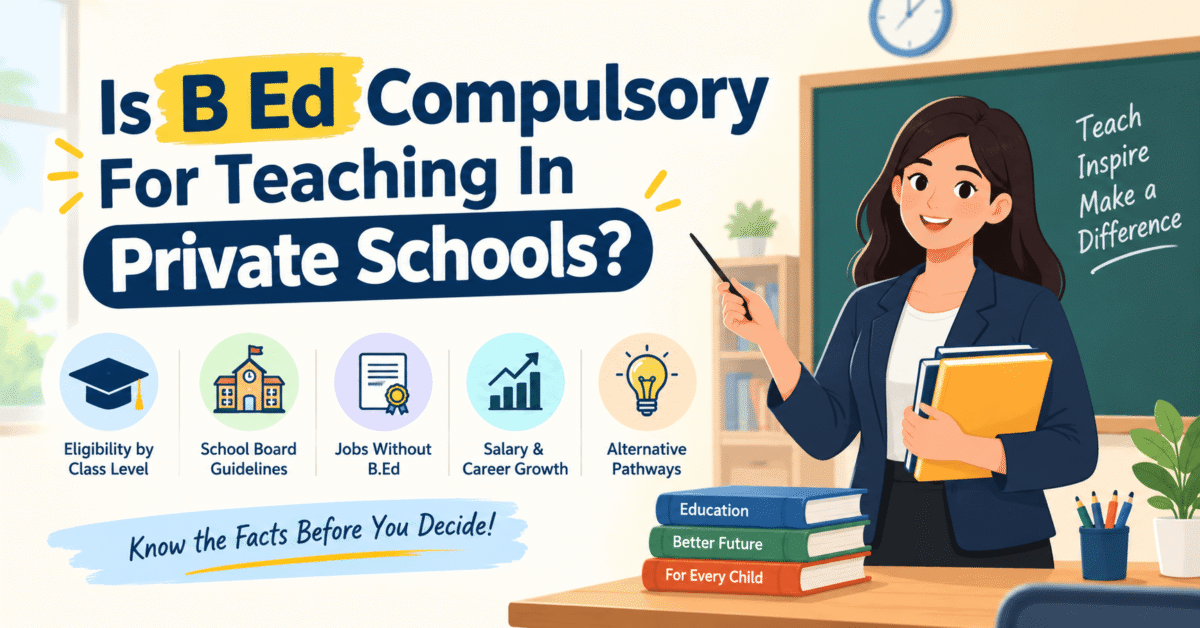
This is a common dilemma among individuals wanting to enter education, whether a professional teaching degree is mandatory for private institutions or not.
Whether a B.Ed. is compulsory for teaching in private schools depends on a few factors:
The class level you plan to teach,
The education board and its guidelines.
Even though having a formal degree is mandatory for senior faculty, the situation is more flexible for private schools.
Level-wise B.Ed requirements
Pre-primary/Kindergarten:
Schools usually prioritise diplomas or Nursery Teacher Training(NTT).
Classes 1-5(PRT):
A full fledged B.Ed degree is not expected even at this level, Rather a diploma in Elementary Education or any other teacher training works fine.
TGT & PGT(Secondary & Senior Secondary:
This is where CBSE and ICSE mandate a B.Ed with a bachelor’s and master’s degree.
Coaching and Tutoring:
Hiring depends on you or mastery on the subject and clear communication. It also depends on your ability to connect with students.
How Non-B.Ed graduates get the job?
We have seen that there is a demand for formal certification on paper, but private schools are independent to make this decision. Graduates without B.Ed do find active employment because of their talent and ability to build rapport with students.
Shortage of Specialists in these Subjects
The struggle is real when it comes to hiring teachers in high demand subjects such as Mathematics, Physics, Computer Science, and now even Artificial Intelligence.
B. Tech, MCA degree holders or even postgraduates in specialised courses are regularly hired because of competency in these fields.
Schools easily grant them a time of two-three years to complete a B.Tech by distance or part-time.
For visual arts, Physical Education, music, dance, and coding, they follow independent training and experience.
C. Ed is replaced by specialisations like B.Ped for sports and training for Arts and Music.
B. Ed vs. Non-B.Ed: Comparison
Employment Status: Teaching with a B.Ed offers permanent and confirmed positions. Whereas, teaching without a B.Ed offers contractual and temporary positions.
Salary Growth: Teaching without a B.Ed often results in lower pay, but B.Ed qualifies the candidate for board-mandated salary structures and annual increments.
Promotion: Teaching without a B.Ed restricts the career advancement of an individual to leadership positions.
Teaching with a B.Ed offers growth and opens pathways that are limited without a B.Ed.
Inspections and Mobility
Teaching without a B.Ed:
A candidate’s name may be excluded during official board inspections, and it may also restrict movement to other institutions.
Teaching with a B.Ed.:
A B.Ed. qualification can improve career opportunities and eligibility for teaching positions at reputed schools.
Alternate Pathways for Aspiring Educators:
You do not need to give up your teaching aspirations while pursuing B.Ed.
Enroll via distance education:
You can complete a B.Ed. program through institutions like IGNOU or open universities while teaching in a private institution.
Build Independent tutoring experience:
There are no restrictions on home tutoring and coaching center roles. You can polish your skills and improve academically while also getting a formal degree on the side.
You can also start with foundational classes using certifications like NTT(Nursery Teacher Training), or early childhood diplomas, which take less time than a full two-year B.Ed course.
Actionable advice:
If you do not have a teaching degree, and you are applying to schools, your demo matters more than your resume or paperwork. Principals may overlook your degree, but they will definitely look for three things: control over the students, blackboard or smartboard work, and ability to explain a tough topic in simple words. Avoid focusing on textbook theory, and show that you can keep the class energetic and keep them curious without losing your calm. Most assessors will happily offer you a job if your demo proves that students are happy with your way of teaching and they understand the concepts taught by you. They may simply ask you to complete your B.Ed on a part-time basis.
Conclusion
Understanding whether ‘is B.Ed compulsory for teaching in private schools’ requires us to separate laws from the actual practices.
Legally, private institutions under CBSE and ICSE mandate a B.eD for permanent roles. In practice, flexible, budget schools and private tutoring institutions welcome experts and encourage them to secure a B.Ed over time.
If your goal is long-term security and leadership, obtaining a B.Ed would be a better choice and a worthy investment.